China Best EV Charger Tester for Commercial Maintenance?

Time:2026-09-26 Author:Oliver
0%

Commercial charging networks are growing, but uptime depends on more than adding stations. The International Energy Agency’s Global EV Outlook 2024 reports that public charging points worldwide increased by about 40% in 2023. Fast chargers grew even faster. More hardware means more connectors, cables, and protective devices to inspect.

Why do I need an EV charger tester for commercial maintenance? Because a charger’s screen can look normal while a connector, protective earth, or control signal fails under test. J.D. Power’s 2024 U.S. Electric Vehicle Experience (EVX) Public Charging Study found that roughly one in five visits ended without a successful charge. That is a real operational problem: a stalled delivery van, a queue at a depot, or a technician returning to the same unit.

Brent Gruber, J.D. Power’s executive director of the EV practice, has emphasized that dependable public charging is essential to improving the driver experience. In practical terms, that means verifying equipment, not just rebooting it. A suitable EVSE tester can help maintenance teams check charging functions and identify faults before returning a unit to service. Its capabilities vary by model, so teams should match the tester to their charger types and maintenance procedures. A tester is not magic. It cannot replace sound diagnosis, and a rushed test can miss intermittent faults. Still, consistent measurements give teams a clearer record of what they checked—and what needs further attention.
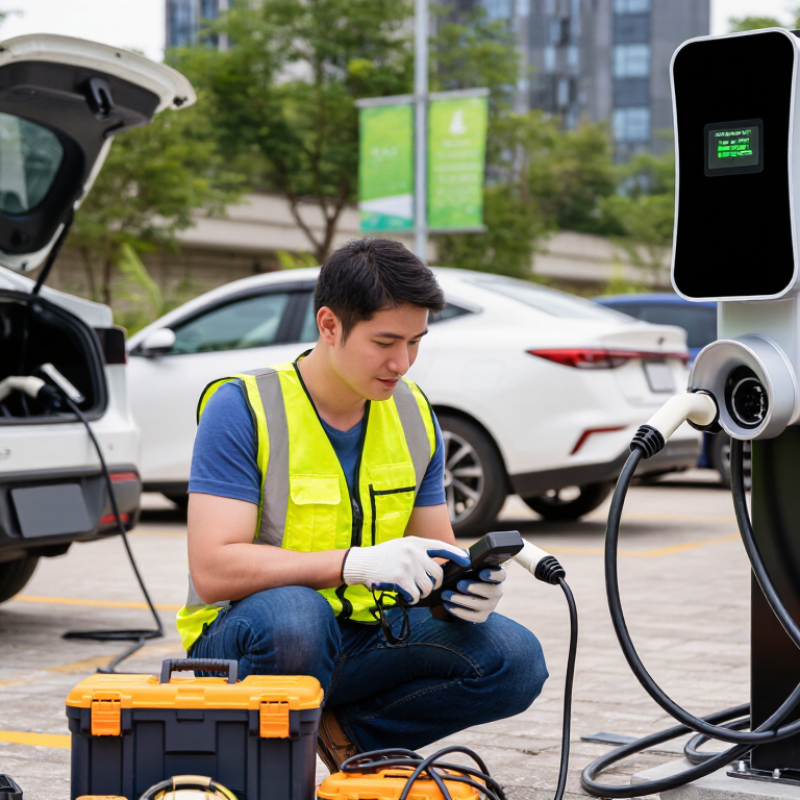
China Best EV Charger Tester for Commercial Maintenance?

What an EV Charger Tester Is and What It Measures

An EV charger tester is a diagnostic instrument that checks whether charging equipment communicates and supplies power as expected. For AC chargers, it can simulate a vehicle connection and examine control-pilot states, proximity signals, supply voltage, wiring, and protective-earth continuity. Some models also test residual-current protection. Capabilities vary, so a basic status check should not be mistaken for a complete safety inspection.

At a service visit, a technician might connect the tester, confirm the charger recognizes a vehicle, then check whether the contactor closes correctly. The display can reveal a missing earth connection or an incorrect pilot signal before a real car is connected. A tester may not measure charging performance under sustained load; that can require separate equipment. A clean reading is not the whole story.

The International Energy Agency’s Global EV Outlook 2024 reports that public charging points grew by about 40% in 2023, exceeding four million worldwide.

More charging equipment means more sites to maintain, but not every fault appears during a quick test. I would still question a pass result if a connector feels loose, shows heat discoloration, or behaves intermittently. Real conditions can be messier than the screen suggests.

Commercial EV Charger Maintenance Requirements

Commercial EV Charger Maintenance Requirements

Commercial chargers face repeated use, weather, and occasional impact from vehicles or equipment. Maintenance should begin with a visual inspection of each unit. Check cable jackets for cuts, connectors for heat marks, and housings for water or dust intrusion. Small details matter. Loose mounting hardware can worsen with vibration, while blocked vents may raise internal temperatures.

A qualified technician should follow the site’s maintenance plan and applicable electrical requirements. Use a suitable EV charger tester to verify communication, protective functions, and charging output under controlled conditions. Record test results, fault codes, repairs, and dates; compare readings over time instead of relying on a single pass. Keep records. Inspection frequency depends on usage, environment, and equipment guidance. After heavy rain or a reported fault, an additional check may be sensible. A checklist helps, but it cannot replace judgment. I have seen routine checks overlook worn cable strain relief, so inspect the points users handle most. Calibration and safe isolation procedures matter, too.

China Best EV Charger Tester for Commercial Maintenance? - Commercial EV Charger Maintenance Requirements

Maintenance Activity Suggested Frequency Suitable Tester or Method What to Check Acceptance and Records
Visual condition and site inspection Routine site checks; frequency set by the operator’s risk and maintenance plan Visual inspection; maintenance checklist Enclosure damage, water ingress, blocked ventilation, loose or damaged cables, connector wear, labels, and signs of overheating Remove damaged equipment from service when safety may be affected. Record findings, actions, and return-to-service status.
Protective conductor continuity At commissioning, after relevant repairs, and during scheduled electrical inspections Low-resistance continuity tester suitable for the installation Continuity of the protective earth path between the charger’s exposed conductive parts and the installation protective conductor Compare results with applicable installation rules, manufacturer instructions, and the site’s commissioning records. Record measured values and test conditions.
Insulation resistance At commissioning or when required after repair or inspection Insulation resistance tester, used with equipment prepared according to its instructions Insulation of the relevant installation circuits and conductors Use the test voltage and pass criteria required by applicable rules. Isolate or protect sensitive electronics as specified by the charger manufacturer.
Residual-current protection At commissioning, after relevant repairs, and at intervals required by local rules or the maintenance plan RCD tester or compatible EVSE test instrument Operation of the installed residual-current protective device and any required DC residual-current detection function Verify operation against the device specification and applicable regulations. Do not apply a single trip-time or leakage threshold to every charger type.
Control-pilot and proximity-pilot functions At commissioning, after repair, and during planned functional testing EVSE tester with vehicle-simulation and control-pilot functions Control-pilot state changes, charging enable sequence, proximity detection, and cable-current coding where applicable Confirm the charger responds correctly to the supported test states and cable ratings. Record the test mode and observed response.
Output voltage, current, and charging sequence At commissioning and after repairs affecting power delivery EVSE tester with a suitable load function, or an approved test load and electrical measuring instruments Output within the charger’s declared operating range, correct session start and stop, and absence of unexpected interruptions Compare readings with the equipment specification and supply conditions. Use instruments rated for the circuit and test category.
Connector, cable, and thermal condition Routine inspection; additional checks after reports of overheating or repeated faults Visual inspection; temperature measurement or thermal imaging where appropriate Connector damage, abnormal heating, discoloration, loose connections, and cable strain or deformation Investigate abnormal temperature patterns or visible heat damage against manufacturer limits and site procedures. Record corrective work.
Communication and remote monitoring During routine operational monitoring and after communications-related faults Charger diagnostics, network checks, and backend event logs Availability, fault reporting, time and transaction records, and communications between the charger and its management system Confirm reported status matches the local charger display and event history. Follow the site’s cybersecurity and data-retention procedures.
Test-equipment suitability Before each test campaign and in line with the instrument calibration schedule Instrument documentation, visual inspection, and calibration records Compatibility with the charger type, connector, electrical rating, test functions, and local measurement requirements Use equipment that is in good condition and within its calibration period where calibration is required. Retain instrument identification and test records.

Important: Maintenance intervals and pass limits depend on charger design, installation conditions, manufacturer instructions, and applicable local regulations. Use this table as a planning aid, not as a substitute for those requirements. IEC 61851 addresses conductive charging systems; installation inspection and testing are also subject to applicable national electrical rules.

Main Types of EV Charger Testers Used in China

China Best EV Charger Tester for Commercial Maintenance?

Main Types of EV Charger Testers Used in China

China’s large charging network makes reliable field testing essential. The International Energy Agency’s Global EV Outlook 2024 reports more than 2.7 million public charging points in China in 2023. That scale matters. Commercial maintenance teams commonly use three tester types: EVSE adapters, electrical installation testers, and communication or performance analyzers.

An EVSE test adapter simulates a vehicle connection and checks control-pilot states, charging initiation, and connector responses. For China’s GB/T equipment, technicians need compatible adapters; a plug that fits is not enough.

Electrical installation testers check protective earth, insulation, and residual-current protection. These checks can reveal faults before a charger returns to service. Communication analyzers inspect data exchange, while load-based systems measure output voltage, current, and power under operating conditions.

Each tool answers a different question. A communication pass does not prove that a cable remains cool under sustained load. A bench result may also miss a loose site connector. Maintenance records should pair measured values with the charger’s location, test conditions, and fault history. I would avoid treating one clean reading as proof of long-term reliability. That is an easy mistake.

Criteria for Comparing Testers for Commercial Use

For commercial maintenance, compare testers by what they verify, not by how many features appear on a product sheet. A useful unit should check voltage, current, protective-earth continuity, insulation, and residual-current protection. It should also simulate charger communication and identify failed steps clearly. That matters when a technician is working beside a vehicle, with limited time and a queue forming.

Scale makes repeatable testing important. The International Energy Agency’s Global EV Outlook 2024 reports that the global public charging network approached four million points in 2023, growing by more than 40% from 2022. A tester should therefore support the AC and DC equipment types found across a service area, with suitable connectors and operating ranges. Check that its calibration is traceable and that reports record test results, date, and equipment identification. Clear records help teams compare faults across sites.

Consider field conditions, too. Can the tester be carried between bays, read in bright light, and operated with gloves? Can it reproduce an intermittent communication fault, rather than only confirm a successful connection? That sounds simple. It isn’t. A compact tester may save setup time but omit useful diagnostic detail; a more capable model may slow routine checks. Teams should trial both on real maintenance tasks. One weak point: test results are only useful when staff know what they mean.

China Best EV Charger Tester for Commercial Maintenance?

Suggested criteria weights for comparing EVSE testers used in commercial maintenance

Safety and applicable-standard verification receive the highest suggested weight, followed by fault simulation and control-pilot/proximity-pilot checks. These percentages are an evaluation framework, not measured product results; adjust them to match your maintenance procedures and local requirements.

How to Select and Use a Tester for Routine Maintenance

China Best EV Charger Tester for Commercial Maintenance?

Selecting a tester for routine maintenance starts with the equipment on site. Check that it supports the charger’s connector type and relevant signaling functions. A useful unit should help verify control-pilot states, protective earth continuity, and basic fault responses. For high-power equipment, confirm its voltage and current ratings before testing. A tester is not automatically a load bank.

Before each visit, inspect the tester, leads, and casing for cracks or loose connections. Follow the charger and tester instructions, and use properly rated equipment. Small clues matter. Connect the tester as specified, then check normal operation and documented fault conditions. Never bypass protective devices to speed up a check. If a reading is unstable, stop and investigate rather than repeating the test blindly.

Record the charger ID, test date, readings, ambient conditions, and any fault indicators. Compare results with earlier records; gradual changes may be more useful than one isolated pass. Keep records. A clean tester result cannot reproduce every vehicle-side issue, and it does not prove every charging session will be trouble-free. That limitation is easy to overlook during a busy maintenance round.

FAQS

What types of EV charger testers are commonly used for maintenance?

Teams use EVSE test adapters, electrical installation testers, and communication or performance analyzers. Each checks a different part of charger operation.

What does an EVSE test adapter check?

It simulates a vehicle connection and checks control-pilot states, charging initiation, and connector responses. The adapter must match the charger’s connector and signaling system.

Can one tester confirm a charger is fully reliable?

No. A communication check cannot show whether a cable heats during sustained load. One clean reading is not a guarantee.

What do electrical installation testers measure?

They check protective earth, insulation, and residual-current protection. These tests can uncover faults before equipment returns to service.

When is a load-based test useful?

It measures voltage, current, and power while the charger operates. A tester is not automatically a load bank, so check its ratings.

What should technicians inspect before a site visit?

Look for cracked casing, damaged leads, or loose connections. Small clues matter. Confirm the tester is rated for the equipment.

What details belong in maintenance records?

Record the charger ID, test date, readings, ambient conditions, and fault indicators. Compare them with earlier results; gradual changes can be easy to miss.

What should a technician do if a reading is unstable?

Stop and investigate instead of repeating the test blindly. Follow the equipment instructions, and never bypass protective devices to speed up a check.

Conclusion

An EV charger tester is a diagnostic tool for checking whether charging equipment operates safely and consistently. Depending on its capabilities, it can assess electrical output, protective functions, connector signals, communication between the charger and a vehicle, and fault responses. Commercial maintenance calls for more than occasional visual checks: routine testing helps identify wear, connection problems, and performance changes before they disrupt charging services. Why do I need an EV charger tester for commercial maintenance? It provides measurable results that help technicians verify operation, investigate issues, and keep maintenance records.

Testers used in China may include portable instruments for basic checks, simulators for testing charger-to-vehicle communication, and more comprehensive systems for detailed diagnostics. When comparing options for commercial use, consider supported charger types, measurement range, test coverage, ease of use, portability, data recording, and suitability for the site’s maintenance routine. Select a tester that matches the equipment and checks required, follow its operating instructions, and conduct tests consistently. Recording results over time makes it easier to spot changes, plan maintenance, and support dependable charging services.

Oliver

Oliver

Oliver is a seasoned marketing professional with a wealth of expertise in driving brand awareness and engagement. With a deep understanding of our company's product offerings, he consistently delivers high-quality content that enriches our professional blog. His insights not only shed light on......