China’s electric-vehicle growth is creating new possibilities for roadside support. The International Energy Agency reported that China sold about 8.1 million electric cars in 2023, nearly 60% of global sales. The China Electric Vehicle Charging Infrastructure Promotion Alliance reported roughly 8.6 million charging points nationwide by the end of that year. These figures show scale, not universal access.
Vehicle-to-vehicle (V2V) charging could help when an EV runs low on a remote road. A compatible donor vehicle might transfer enough energy to reach a nearby charger. In practice, drivers need compatible equipment, safe connections, clear operating procedures, and a way to locate a willing vehicle. Those details matter. Not every EV supports power transfer, and a small energy boost may not solve a longer-range problem.
Can V2V charging be used as a roadside assistance service? In principle, yes—but it is better understood as a possible supplement, not a guaranteed replacement for recovery trucks or mobile charging units. The IEA and charging-infrastructure figures describe market growth; they do not prove that V2V assistance is widely available. That gap deserves attention. A stranded driver needs reliable help, not just an appealing technical concept. This introduction examines what leading Chinese V2V chargers may offer, how the service could work, and where practical limits remain.
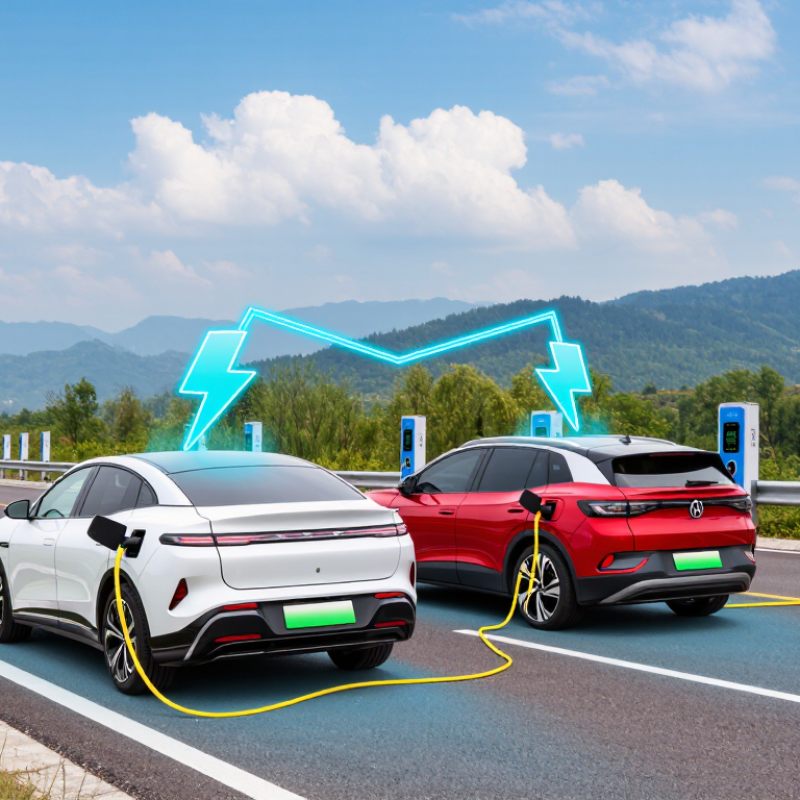
China’s vehicle-to-vehicle (V2V) chargers transfer energy from one electric vehicle to another through power-control equipment and a compatible cable. In some systems, the donor vehicle supplies direct current; others rely on an external converter. The receiving vehicle’s battery-management system monitors voltage, temperature, and charging limits. Equipment and vehicle capabilities vary, so not every pair can connect.
A driver parks the vehicles close together, connects the charging cable, and follows the equipment’s operating instructions. The charger and vehicles check whether their electrical systems can communicate safely before power flows. Charging may stop if temperatures rise or a connection becomes unstable. Small details matter. A cable that fits physically does not guarantee compatibility, and V2V charging is not a universal feature.
For roadside assistance, the practical goal is usually to provide enough energy to reach a nearby charging point, not to refill a battery. The transfer can take time, and the donor vehicle loses some usable range. Weather, battery condition, and the charger’s output can also affect results. The awkward part is that “emergency charging” may sound faster or simpler than it is; drivers should check vehicle guidance and equipment limits before relying on it.
| Topic | How It Works | Roadside Assistance Relevance |
|---|---|---|
| What a V2V charger is | A vehicle-to-vehicle (V2V) charging system transfers electrical energy from one electric vehicle’s battery to another vehicle’s battery through compatible charging equipment. | A vehicle with sufficient charge may provide another EV with enough energy to reach a charging station or a safer location. |
| Typical equipment | Depending on the system, equipment may include a dedicated bidirectional charger, protected cables and connectors, and control electronics that manage power flow and communication. | A portable unit can support mobile assistance, but it must be designed for the vehicles and charging method involved. |
| Basic operating steps | The vehicles are parked safely, connected using compatible equipment, and checked by the system. The charger then controls the transfer and stops when its limits or the selected charge target are reached. | The process can provide a controlled top-up without requiring a fixed charging station at the scene. |
| Power and charging time | Transfer power varies by charger, vehicle capability, battery condition, and operating limits. As an illustration, transferring 10 kWh at a steady 10 kW would take about one hour in ideal conditions; real charging can take longer. | V2V charging is generally better suited to a useful top-up than to quickly filling a large battery from empty. |
| China charging interfaces | China’s GB/T standards define charging interfaces and related requirements. A matching connector alone does not guarantee that two vehicles and a V2V unit can communicate or transfer power together. | Compatibility should be confirmed for the specific vehicle models, charging ports, and equipment before roadside use. |
| Energy available to give | The donor vehicle must retain enough battery charge for its own journey. The usable amount is limited by its battery level, vehicle settings, and the system’s minimum reserve. | A donor vehicle may be unable to help if its remaining range is low or its vehicle does not support the required power output. |
| Safety controls | Suitable equipment monitors conditions such as connection status, current, voltage, and temperature, and includes protective measures against faults. Users should follow the equipment and vehicle instructions. | Charging should take place in a safe, permitted location—not in moving traffic, standing water, or other hazardous conditions. |
| What it cannot fix | V2V charging supplies electrical energy; it does not repair a damaged battery, failed charging system, punctured tire, or other mechanical fault. | If the vehicle has a fault or cannot accept a charge, professional roadside service or towing may still be necessary. |
| Practical takeaway | V2V charging can be a flexible way to transfer energy between compatible EVs, subject to vehicle capability, equipment, location, and safety requirements. | It can assist with some low-battery situations, but it is not a universal substitute for public charging infrastructure or roadside recovery. |
It transfers energy from a compatible service vehicle to a stranded EV. The goal is reaching a nearby charging point, not restoring a full battery.
Sometimes, if the receiving car needs only a short energy boost. It may reduce unnecessary towing, but it cannot fix every breakdown.
Drivers should not expect a full recharge. Transfer speed and available energy vary, and conversion losses reduce the energy received. Not a full recharge.
Confirm both vehicles support the equipment, settings, voltage limits, and communication protocols. A matching connector alone is not enough.
Park securely away from moving traffic, with the cable clear of tires. Avoid narrow shoulders, poor lighting, and wet connectors. Stop if the setup feels unsafe.
Stop if connectors become hot, warning lights appear, or charging repeatedly interrupts. Follow the vehicle manuals rather than pushing through a fault.
It gives up more energy than the other car receives because conversion causes losses. The helper may have less range than expected. A real trade-off.
Keep suitable cables and safety equipment in the service vehicle. Train operators, check the donor vehicle’s charge, and guide drivers to a verified charging point. Honestly, the setup can feel fussier than expected.
Vehicle-to-vehicle (V2V) chargers allow one electric vehicle to transfer power to another through compatible charging equipment and vehicle systems. In a roadside emergency, a charged vehicle may provide enough energy to help a stranded vehicle reach a nearby charging point or a safer location. Can V2V charging be used as a roadside assistance service? It can serve as a useful form of peer-to-peer support, but it is not a complete replacement for professional roadside assistance.
Whether a power transfer is possible depends on vehicle compatibility, charging connectors, communication protocols, and the equipment available. V2V charging can offer flexibility when conventional charging is out of reach, yet the process may be slow and will reduce the donor vehicle’s remaining range. Drivers should follow vehicle instructions, use approved equipment, and avoid attempting a transfer if there are signs of damage, overheating, or unsafe conditions. Practical limits such as weather, location, and the amount of charge available also determine whether V2V assistance is a suitable option.

 Rama Charger